Preparing for the TRCN exam can feel overwhelming. Many Nigerian teachers—new graduates, experienced classroom practitioners in Kano or Lagos private schools, and even those switching from other fields—worry about the process, costs, and whether it’s truly necessary. If you’re an aspiring teacher, a current private school educator without a license, or someone aiming for career growth, this article will give you clear, practical answers.
You’ll learn the current status of TRCN registration for private school teachers, why the Federal Government is tightening rules, the exact requirements, benefits, challenges, and actionable strategies to pass the Professional Qualifying Examination (PQE) and secure your Nigerian teaching license. By the end, you’ll know exactly what steps to take to protect your career and advance professionally.
What is TRCN and Why Does It Exist?
The Teachers Registration Council of Nigeria (TRCN) is the statutory body established by the TRCN Act (Decree 31 of 1993, now CAP T3 of 2004) to regulate the teaching profession. Its core mandates include determining who qualifies as a teacher, setting professional standards, conducting the Professional Qualifying Examination (PQE), issuing certificates and licenses, and enforcing discipline.
TRCN exists to professionalize teaching in the same way the Nigerian Medical Council or the Council for Legal Education regulates doctors and lawyers. Unqualified or unethical individuals should not stand before Nigerian children in classrooms. Registration separates genuine professionals from “charlatans and misfits,” as noted in various analyses of the Act.
The Professional Qualifying Examination (PQE) is the gateway. It is a computer-based test covering education foundations, teaching methodology, curriculum, classroom management, ethics, and subject-specific knowledge, depending on your category (NCE, B.Ed, PGDE, etc.).
Is TRCN Registration Mandatory for Private School Teachers?
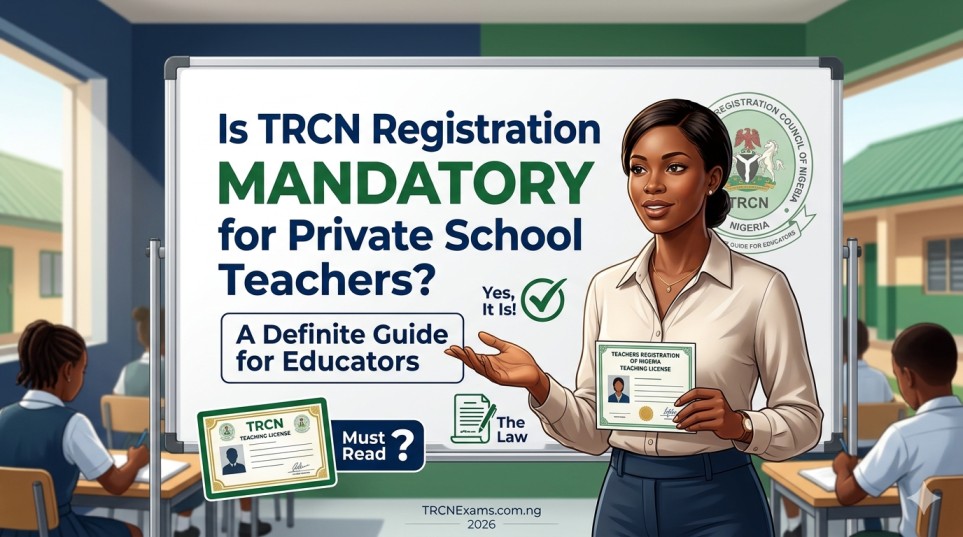
Yes, TRCN registration is mandatory for private school teachers in Nigeria.
The Federal Ministry of Education has made this clear through recent directives. All teachers—whether in public or private (non-state) schools—must be registered, certified, and licensed by TRCN to practice legally. This applies across nursery, primary, secondary, and tertiary levels.
Key policy updates:
- From 2026, private schools are expected to have at least 75% of their teachers TRCN-certified.
- By 2027, 100% compliance is required. Schools failing to meet this risk losing accreditation as examination centres for WAEC, NECO, NABTEB, and other national exams.
The Ministry has explicitly warned: “No teacher should teach without TRCN registration.” This directive covers both public and private sectors. Private school proprietors who ignore it face operational consequences, including potential closure of exam centres or loss of approval.
TRCN maintains a dedicated Department of Private Schools focused on mobilizing, sensitizing, and registering teachers in the private sector, conducting background checks, and ensuring compliance.
In plain terms: If you teach in a private school in Rivers State, Lagos, Abuja, or anywhere in Nigeria without a TRCN license, you are practicing without full legal backing. Proprietors increasingly demand the license during hiring and for retention, especially as enforcement ramps up.
Legal and Professional Implications of Non-Registration
The TRCN Act makes unregistered practice an offence. Penalties can include fines, suspension, deregistration, or even prosecution. While enforcement has historically varied, the 2025–2027 push by the Ministry of Education signals stricter compliance.
Consequences for teachers:
- Inability to participate in certain government recruitments (e.g., SUBEB, TESCOM).
- Limited promotion prospects.
- Risk of job loss as schools align with new accreditation rules.
- Schools may refuse to employ or retain unlicensed teachers to protect their own status.
For private school owners: Non-compliance threatens exam centre status and overall school approval. Many proprietors now prioritize TRCN-licensed teachers to avoid sanctions.
Expert Tip: Treat TRCN registration as non-negotiable for long-term career security. View it as an investment in professionalism, similar to how accountants pursue ICAN or engineers pursue COREN.
Who Needs to Register? Eligibility for TRCN
You are eligible if you possess a recognized teaching qualification:
- Nigeria Certificate in Education (NCE)
- Bachelor’s degree in Education (B.Ed, B.A. Ed, B.Sc. Ed)
- Postgraduate Diploma in Education (PGDE/PDE) for those with non-education degrees
- Higher degrees (Master’s or PhD in Education)
Note: A plain BSc, BA, or HND without a PGDE does not qualify you to register as a professional teacher. You must complete the PGDE first.
TRCN categorizes applicants (A–D) based on qualification level, which affects fees and exam focus.
Required Documents (typical checklist):
- Academic certificates and transcripts
- Birth certificate or declaration of age
- Passport photographs
- Proof of payment
- NYSC discharge certificate (where applicable)
- Valid ID (National ID, Driver’s License, etc.)
Always verify the latest checklist on the official TRCN portal (trcn.gov.ng).
Step-by-Step TRCN Registration Process
- Check Eligibility — Confirm you have the minimum teaching qualification.
- Visit the Official Portal — Go to trcn.gov.ng or teachers.trcnigeria.ng. Create an account.
- Complete the Online Application — Fill the form accurately and upload documents.
- Pay Fees — Use Remita or approved channels. Fees vary by category and status (fresh graduate vs. in-service). Expect costs covering PQE, certificate, and initial 3-year license (typically ₦15,000–₦50,000+ depending on level; confirm current figures on the portal as they can adjust).
- Prepare for and Sit the PQE — Exams are usually held in May and November. It is computer-based (CBT) with 60–100 questions.
- Induction and Licensing — Upon passing, complete induction and receive your certificate and license.
- Renewal — Licenses are renewed periodically with proof of continuing professional development (CPD) and payment of dues.
Pro-Strategy for Busy Private School Teachers: Register early to avoid portal congestion and last-minute rushes. Many teachers in private schools combine this with their teaching load—start preparation 3–4 months before the exam window.
The TRCN Professional Qualifying Examination (PQE): What to Expect
The PQE tests professional knowledge rather than just academic content. Areas typically covered include:
- Philosophy and Sociology of Education
- Curriculum Development and Implementation
- Educational Psychology and Classroom Management
- Measurement and Evaluation
- Teaching Methods and Micro-Teaching
- Professional Ethics and TRCN Act
- Inclusive Education and Special Needs
- Current Issues in Nigerian Education
Expert Tips for TRCN Exam Prep:
- Master the Syllabus: Focus on “Areas of Concentration” (AOC). TRCN questions often draw from 20–23 core topics.
- Practice Extensively: Use past questions and practice tests. TRCN sometimes twists familiar questions, so understand concepts, not just memorize.
- Time Management: The CBT format requires speed and accuracy. Practice with timed mocks.
- Study Smart in the Nigerian Context: Relate topics to real classroom challenges in private schools—large classes, mixed-ability learners, limited resources, and cultural diversity.
- Join Study Groups: Many teachers form WhatsApp or local groups for discussion and motivation, especially in cities like Port Harcourt.
Common Pitfall to Avoid: Relying only on past questions without understanding underlying principles. Examiners test application.
Pro-Strategy: Dedicate time daily even if you teach full-time. Use early mornings or weekends. Combine official TRCN practice resources with quality past question compilations that explain answers. Aim to score well above the pass mark for confidence.
Benefits of Getting Your Nigerian Teaching License
- Professional Recognition: You join a regulated body like other esteemed professions.
- Career Advancement: Better job opportunities, promotions, and eligibility for headship or government roles.
- Job Security: As enforcement increases, licensed teachers become more employable in compliant private schools.
- Continuous Development: Access to CPD programs that improve your teaching skills and student outcomes.
- Global Alignment: Positions you for opportunities aligned with international teaching standards.
- Personal Pride: Knowing you meet national benchmarks for quality education delivery.
Licensed teachers contribute to elevating the overall standard of education in Nigeria, which benefits pupils in both private and public schools.
Challenges Faced by Private School Teachers and How to Overcome Them
Private school teachers often face:
- Tight Schedules: Long teaching hours and administrative duties leave little study time.
- Cost Concerns: Fees, study materials, and possible travel to exam centres.
- Portal and Administrative Issues: Occasional technical glitches on the registration portal.
- Proprietor Resistance: Some owners still prioritize cost over qualification.
Practical Solutions:
- Budget in advance and view fees as a career investment.
- Use affordable or free online resources and past questions.
- Negotiate study leave or flexible hours with understanding proprietors who want compliant schools.
- Start with free TRCN practice exams and targeted past questions to build momentum without heavy initial spending.
Many experienced private school teachers have successfully balanced this by preparing incrementally over months.
Expert Tips and Pro-Strategies for Success in the Nigerian Education Sector
- Start Early: Don’t wait for the 2027 deadline. Register and prepare now while slots and support are more available.
- Leverage Technology: Use mobile-friendly practice platforms for on-the-go revision during free periods.
- Network: Connect with licensed colleagues and join teacher forums for updates on policy changes.
- Document Everything: Keep copies of all submissions and payments.
- Focus on Ethics and Practice: TRCN emphasizes professionalism—demonstrate this in your daily teaching.
- For Aspiring Teachers: If you have a non-education degree, enroll in a reputable PGDE program first. Many universities and NTI offer flexible options.
Table: Quick Comparison – Registered vs. Unregistered Teacher (Private School Context)
| Aspect | Registered (TRCN Licensed) | Unregistered |
|---|---|---|
| Legal Status | Fully authorized to teach | Practicing at risk |
| Job Prospects | Preferred by compliant schools | Increasingly rejected |
| Exam Centre Accreditation Impact | Supports school compliance | Puts school at risk of losing status |
| Career Growth | Promotions, leadership roles | Limited |
| Professional Development | Access to CPD and renewal | No formal recognition |
| Deadline Readiness (2027) | Ready | Needs urgent action |
Conclusion: Secure Your Future as a Professional Teacher
TRCN registration is not optional—it is a mandatory requirement for private school teachers in Nigeria, backed by law and reinforced by current Federal Ministry of Education policy. With the 2026–2027 compliance deadlines approaching, acting now protects your job, enhances your professionalism, and positions you for growth in a sector that increasingly values quality and accountability.
The process—though it requires effort—opens doors to a more respected and sustainable teaching career. Passing the TRCN exam demonstrates your commitment to excellence and equips you with knowledge that directly improves classroom outcomes for Nigerian children.
Don’t let uncertainty hold you back. Thousands of teachers have successfully navigated this path and emerged stronger. You can too.
Take Action Today: Visit trcnexams.com.ng to access Free Practice Exams and Download our TRCN Past Questions with detailed explanations. Start your preparation with proven materials tailored for Nigerian teachers. Your Nigerian teaching license is within reach—begin the journey now and build the career you deserve.
Equip yourself. Register. Pass. Teach with confidence and authority.
This article is for informational purposes and reflects policies as of 2026. Always verify the latest requirements directly on the official TRCN website (trcn.gov.ng) as fees, dates, and procedures may be updated.