Preparing for the TRCN exam can feel overwhelming. Many Nigerian teachers—whether fresh NCE graduates, aspiring educators, or experienced classroom practitioners juggling lesson notes, overcrowded classes, and administrative duties—worry about the Professional Qualifying Examination (PQE). One section that consistently challenges candidates is Educational Psychology. Yet, mastering it is one of the smartest investments you can make for both your Nigerian teaching license and your daily effectiveness in the classroom.
This guide breaks down the core concepts in plain English. It equips you with what you need to pass the TRCN exam while giving you practical tools to manage real Nigerian school realities—from large class sizes in public primary schools in Port Harcourt or Lagos to motivating adolescents in secondary schools facing exam pressure. By the end, you will understand key theories, their classroom applications, and proven strategies to boost your exam score and teaching confidence.
What Is Educational Psychology and Why Does It Matter for TRCN?
Educational Psychology is the scientific study of how people learn, develop, and behave in educational settings. It applies psychological principles to teaching and learning processes, helping teachers understand learners’ minds, motivations, and challenges.
For TRCN candidates, this area typically covers child, adolescent, and adult psychology; human growth and development; learning theories; motivation; individual differences; memory and forgetting; and classroom management. Questions often test your ability to apply these concepts rather than just memorize definitions.
Why it matters: Passing the TRCN PQE is mandatory for obtaining or renewing your professional teaching license in Nigeria. More importantly, educational psychology helps you move from “surviving” the classroom to truly transforming learners. In Nigerian schools, where resources can be limited and learner diversity high (urban vs. rural, different socio-economic backgrounds, multilingual settings), these insights become survival skills.
Human Growth and Development: Understanding Your Learners
A foundational pillar in TRCN Educational Psychology is human development across physical, cognitive, social, emotional, and moral domains.
Key Stages of Development:
- Infancy and Early Childhood: Rapid physical growth and sensory-motor exploration.
- Middle Childhood: Concrete thinking and skill-building (primary school years).
- Adolescence: Identity formation, abstract thinking, and emotional turbulence (common in JSS and SSS).
- Adulthood: Continued learning and responsibility.
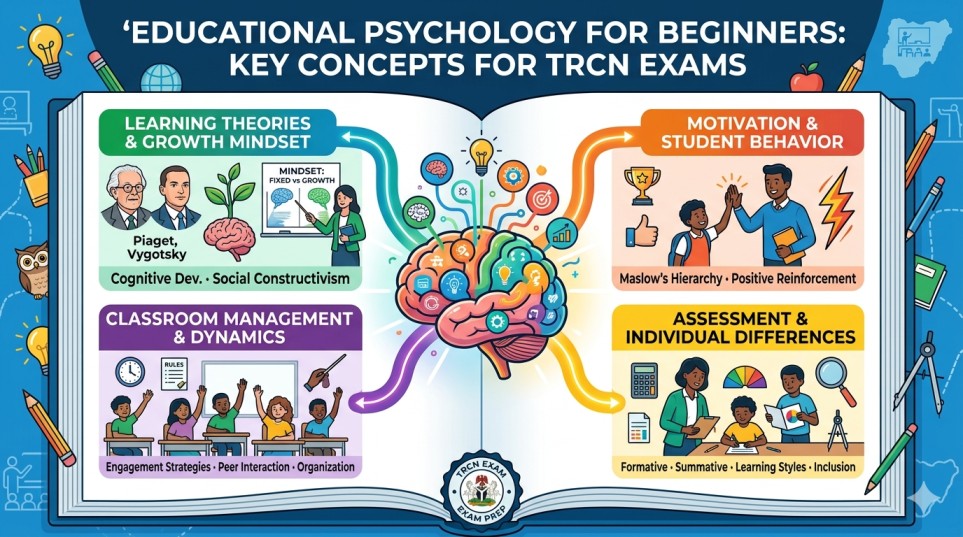
Jean Piaget’s Cognitive Development Theory is frequently tested. Piaget proposed four stages:
- Sensorimotor (birth–2 years)
- Preoperational (2–7 years)
- Concrete Operational (7–11 years)
- Formal Operational (11+ years)
Expert Tip: In a typical Nigerian primary classroom, many pupils operate at the concrete operational stage. Use manipulatives, real objects, and examples from local culture (e.g., market trading or farming) instead of abstract lectures. For SS students, introduce debates and hypothetical scenarios to support formal operational thinking.
Lev Vygotsky’s Sociocultural Theory emphasizes social interaction and the Zone of Proximal Development (ZPD)—the gap between what a learner can do independently and what they can achieve with guidance from a “More Knowledgeable Other” (teacher or peer). Scaffolding (temporary support) is key.
In Nigerian schools with large classes, pair stronger students with those needing help during group work. This aligns with our communal values while addressing individual needs.
Individual Differences: Heredity and environment both shape learners. Factors like nutrition, home background, and access to quality early education vary widely across Nigeria. Recognize these without lowering expectations—differentiate instruction instead.
Pro-Strategy for TRCN: Expect questions on how heredity vs. environment influences learning outcomes or personality development (e.g., Freud’s psychoanalytic theory or trait theories). Link them to practical scenarios like managing a slow learner from a disadvantaged background.
Major Learning Theories Every TRCN Candidate Must Master
Learning theories explain how learning occurs. TRCN exams frequently ask which theory best fits a classroom situation or which emphasizes the teacher’s role.
1. Behaviorism
Associated with Ivan Pavlov, John Watson, and B.F. Skinner. Learning is a change in observable behavior shaped by stimuli, rewards, and punishments (reinforcement).
- Classical Conditioning: Associating stimuli (e.g., bell with break time).
- Operant Conditioning: Rewards increase behavior; punishment decreases it.
Classroom Application: Use praise, stars, or house points for good behavior and academic effort. Be careful with punishment—over-reliance can demotivate. In Nigerian public schools, positive reinforcement often works better than corporal punishment, which is now regulated.
2. Cognitivism
Focuses on internal mental processes: how learners perceive, store, and retrieve information. Jean Piaget is central here.
Key ideas include schemas (mental frameworks), memory processes, and problem-solving.
Application: Help students organize information using mind maps, advance organizers, or summaries. Teach study skills like summarization and elaboration rather than rote memorization alone.
3. Constructivism
Learners actively build (construct) knowledge based on prior experiences. Vygotsky and Jerome Bruner are key figures.
Emphasizes hands-on learning, collaboration, and discovery.
Nigerian Context: Use project-based learning tied to local issues (e.g., environmental projects on flooding in the Niger Delta or agriculture). Group discussions in mother tongue or code-switching can aid understanding before switching to English.
4. Humanism
Abraham Maslow’s Hierarchy of Needs and Carl Rogers’ learner-centered approach. Learning flourishes when basic needs (physiological, safety, belonging) are met, leading toward self-actualization.
Application: Create emotionally safe classrooms. A hungry or fearful child cannot focus on algebra. Simple acts like greeting students warmly or ensuring a clean, orderly space build belonging.
Expert Tip: In under-resourced schools, address safety and esteem needs first. Celebrate small wins publicly to boost intrinsic motivation.
Motivation: Igniting the Desire to Learn
Motivation is a recurring TRCN topic. Distinguish intrinsic (internal satisfaction, curiosity) from extrinsic (external rewards like grades or gifts).
Maslow’s Hierarchy reminds us that unmet basic needs block higher motivation. Self-Determination Theory (autonomy, competence, relatedness) also helps.
In Nigerian secondary schools, many students are extrinsically driven by WAEC/NECO success for future opportunities. Balance this by connecting lessons to real-life benefits (e.g., science to health or technology careers).
Factors Affecting Learning and Motivation:
- Teacher enthusiasm and rapport
- Relevant, culturally responsive content
- Clear goals and feedback
- Classroom environment (overcrowding, noise, ventilation)
Pro-Strategy: Build rapport early. Learn students’ names and a bit about their lives. In large classes, use “think-pair-share” to give everyone a voice without chaos.
Memory, Forgetting, and Transfer of Learning
Memory involves encoding, storage, and retrieval. Rote learning (common in exam-focused systems) has limits—pair it with meaningful understanding.
Forgetting occurs due to interference, decay, or lack of retrieval cues. Techniques like spaced repetition and over-learning help.
Transfer of Learning: Applying knowledge from one context to another (positive or negative). Teach for transfer by using varied examples and encouraging analogies.
In practice: When teaching English comprehension, link it to interpreting government policies or news in local languages.
Classroom Management and Individual Differences
Effective classroom management is rooted in educational psychology. Set clear rules, build positive relationships, and use preventive strategies.
Handle individual differences through differentiated instruction—varying content, process, or product based on readiness, interest, and learning profile.
Nigerian Reality: Overcrowded classrooms (sometimes 50–100+ pupils) require creative solutions like rotating group leaders, peer teaching, or low-cost visual aids made from local materials.
Expert Tips for Nigerian Teachers:
- Establish routines from day one (e.g., morning assembly procedures, quiet signals).
- Use positive language: “Let’s work together quietly” instead of constant scolding.
- Incorporate culturally relevant examples to reduce alienation.
- For special needs or gifted learners, advocate within school systems even when resources are scarce—small adaptations matter.
Guidance and Counseling Link: Educational psychology overlaps with basic counseling skills for identifying emotional or behavioral issues.
Assessment and Evaluation in Educational Psychology
Understand formative vs. summative assessment. Provide timely, specific feedback that helps learners improve (assessment for learning).
Avoid over-testing. Use varied methods: observations, projects, oral questions, and written tests to accommodate different abilities.
Pro-Strategies for TRCN Exam Success
- Understand, Don’t Just Memorize: Expect scenario-based questions (e.g., “A teacher notices low participation in a large JSS class. Which theory or strategy best applies?”).
- Link Theories to Practice: Always think “How would I use this in a Nigerian public or private school?”
- Use Mnemonics: For Piaget’s stages—SPeCoFo (Sensorimotor, Preoperational, Concrete, Formal).
- Practice Past Questions: Identify patterns—many revolve around learning theories, motivation, development stages, and classroom applications.
- Teach Others: Explain concepts to a colleague or study group. Teaching reinforces understanding.
- Time Management: Allocate study time proportionally—educational psychology often carries significant weight.
Actionable Study Plan:
- Week 1–2: Master development theories and stages.
- Week 3: Dive into learning theories with classroom examples.
- Week 4: Focus on motivation, memory, and management; solve 50+ past questions.
- Revise weak areas using the comparison table above.
Conclusion: From TRCN Success to Classroom Excellence
Educational Psychology is not just another TRCN exam topic—it is the science that turns good teachers into great ones. By understanding how learners grow, learn, and stay motivated, you become better equipped to handle the unique challenges and opportunities in Nigerian schools.
Master these concepts, and you will pass your TRCN Professional Qualifying Examination with confidence while gaining skills that elevate your career and impact on students. The Nigerian teaching license is your gateway to professional recognition—pair it with deep pedagogical knowledge for lasting success.
Your learners—and your professional future—deserve your best. Begin now.