Preparing for the TRCN Professional Qualifying Examination (PQE) can feel overwhelming for many Nigerian teachers. Whether you’re a fresh NCE graduate in Category D, a B.Ed or PGDE holder in Category C, or an experienced educator aiming for higher categories, the pressure to secure your Nigerian teaching license is real. The exam tests not just what you know, but your ability to apply professional knowledge in real classroom settings across Nigeria—from urban schools in Lagos to rural classrooms in Ogoja or the North.
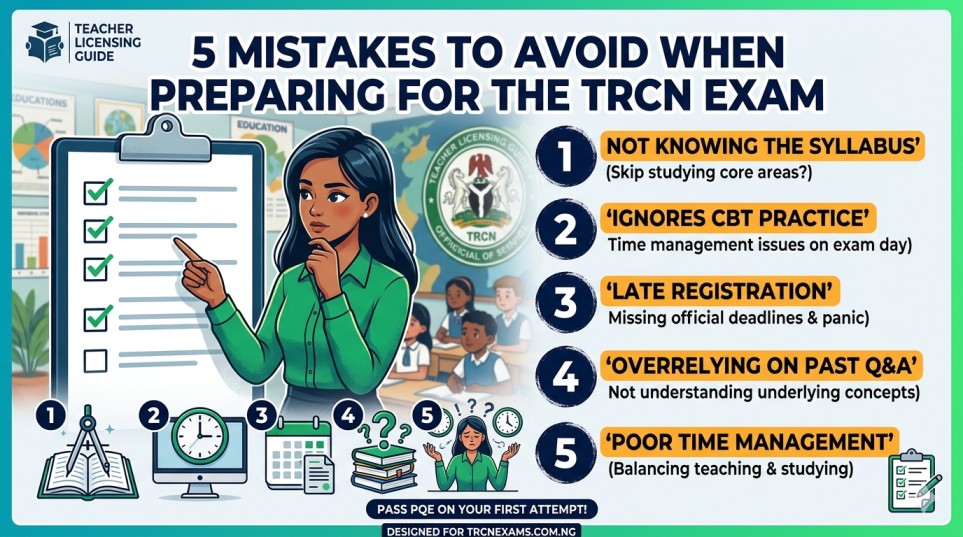
Many dedicated teachers fail or barely scrape through not because they lack intelligence, but because they fall into common preparation traps. This article reveals the 5 critical mistakes to avoid in your TRCN exam prep. By sidestepping these pitfalls, you’ll study smarter, build genuine competence, and greatly increase your chances of passing on the first attempt. Let’s equip you with practical, experience-backed strategies tailored to the realities of teaching in Nigeria.
Understanding the TRCN Exam: Why Preparation Matters
The TRCN PQE is a computer-based test (CBT) with 60 multiple-choice questions to be answered in 60 minutes. The pass mark is 50% (30 correct answers). Questions draw from core areas of education, including Foundations of Learning, Instructional Planning, Teaching Methodologies, Classroom Management, Differentiated Instruction, and Assessment and Evaluation. The syllabus is now streamlined but still demands understanding of Nigerian-specific contexts like inclusive education, cultural influences on learning, large class management, and professional ethics.
Passing grants you the professional teaching license required for career progression, promotions, and even international opportunities. Failing three times can lead to a one-year suspension from rewriting. With thousands registering for batches in May and November, early and strategic TRCN exam prep is non-negotiable.
Now, let’s dive into the mistakes that hold many back.
Mistake 1: Relying Solely on Cramming Past Questions Without Understanding Concepts
One of the most widespread errors is treating TRCN past questions like magic spells—cramming answers word-for-word hoping for exact repeats. While past questions are invaluable and many concepts recur, the TRCN often rephrases them or tests the same topic from a different angle.
For example, a question on Philosophy of Education might ask about the “father of Pragmatism” in one sitting and then test its classroom application (learning by doing, problem-solving) in another. Cramming leaves you stranded when the wording changes.
Why this hurts Nigerian teachers especially: Many candidates juggle teaching jobs, family responsibilities, and lesson planning. Cramming feels like a quick fix after a long day in a noisy classroom of 60+ pupils, but it builds shallow knowledge that crumbles under the CBT timer.
Pro-Strategy: Use past questions to identify patterns and weak areas, then go back to the underlying principles. Study the “why” behind each answer. Link concepts to your daily experience—how John Dewey’s ideas apply when managing a large mixed-ability class in a public secondary school in Rivers State.
Expert Tip: After attempting a set of past questions, spend time explaining the correct answers in your own words as if teaching a colleague. This active recall strengthens retention far better than passive reading.
Mistake 2: Ignoring or Misusing the Official TRCN Syllabus
Many aspiring teachers download random study materials or rely on outdated notes from their university days without consulting the current TRCN syllabus. The exam now emphasizes five core areas with specific weightings, and questions reflect professional competencies needed in Nigerian schools today, including ICT in education, differentiated instruction for diverse learners, and addressing social-emotional needs.
Skipping the syllabus means wasting precious time on low-yield topics while neglecting high-impact ones like Classroom Management (16%) or Assessment and Evaluation (16%).
Real-world Nigerian context: In under-resourced schools, teachers face overcrowded classrooms, limited teaching aids, and students from varied linguistic and socioeconomic backgrounds. The syllabus tests how well you can adapt universal principles to these realities—something generic foreign materials often miss.
Pro-Strategy: Download the official or recommended syllabus early. Break it into manageable weekly chunks. Create a study timetable that allocates more time to your weak areas (e.g., if you’re strong in Philosophy but struggle with Educational Statistics or Guidance and Counselling).
Expert Tip: Map syllabus topics to real challenges you’ve faced. For “Differentiated Instruction,” reflect on how you’ve handled gifted pupils alongside those with learning difficulties in the same class. This makes abstract concepts stick and prepares you for application-based questions.
Mistake 3: Poor Time Management and Last-Minute Preparation
Waiting until a few weeks before the exam or relying on “miracle” night reading sessions is a recipe for anxiety and poor performance. The TRCN PQE demands steady, consistent effort because the questions test integrated knowledge across education foundations.
Many teachers underestimate the mental stamina needed for a timed CBT, especially after a full day of teaching or when dealing with NEPA power issues and data costs for online practice.
Why it fails in Nigeria: Irregular power supply, family obligations, and the demands of the school calendar (terms, exams, extracurriculars) make last-minute rushes chaotic.
Pro-Strategy: Start preparation at least 8–12 weeks before your scheduled batch. Use a realistic timetable: 1–2 hours daily during weekdays and longer blocks on weekends. Incorporate short, focused sessions rather than marathon cramming.
Include practice under exam conditions—60 questions in 60 minutes using a computer or phone to simulate the CBT environment. Factor in potential technical glitches at exam centers by practicing with varied devices.
Expert Tip: Join or form small study groups with fellow teachers in your local government area. Discuss topics like “inclusive education in Nigerian public schools” or “handling indiscipline without corporal punishment.” Teaching others reinforces your own understanding.
Mistake 4: Neglecting CBT Practice and Exam-Day Readiness
Even candidates who know the content sometimes underperform because they’re unfamiliar with the computer-based format, time pressure, or simple logistics like mouse navigation under stress.
Some arrive at the center without practicing timed mocks, leading to panic when the clock starts ticking. Others make technical errors or fail to manage anxiety.
Common Nigerian challenges: Limited access to reliable computers or steady internet in some areas, plus the stress of traveling to designated CBT centers.
Pro-Strategy: Dedicate regular time to TRCN CBT practice exams that mirror the real test. Focus on speed and accuracy. Review every mistake thoroughly—understand not just the right answer but why the other options are wrong.
Build exam-day confidence by preparing your logistics early: confirm your center, test your login details if provided, and practice deep breathing for nerves.
Expert Tip: Simulate distractions during practice. Study or practice with background noise similar to a busy exam hall. This desensitizes you so real conditions feel manageable.
Mistake 5: Failing to Balance Theory with Practical Teaching Experience
Some treat the TRCN exam as purely academic, forgetting that it certifies professional teachers. They memorize definitions but struggle with scenario-based questions that ask what a competent teacher would do in a Nigerian classroom—dealing with mother-tongue interference in English lessons, managing large classes, or promoting gender-sensitive teaching.
Over-reliance on theory without reflection leads to answers that sound good on paper but don’t reflect best practices in our context.
Pro-Strategy: Actively connect every topic to your classroom reality. When studying Curriculum Development, think about how the Nigerian National Policy on Education influences what you teach. For Educational Psychology, recall how motivation strategies work (or fail) with pupils facing economic hardships.
Keep a “TRCN Reflection Journal.” For each major topic, note one real-life application or challenge from your school and how professional knowledge helps address it.
Expert Tip: Review current issues in Nigerian education—such as the impact of insecurity on learning continuity or the push for digital literacy. TRCN questions often probe awareness of these professional realities.
Bonus: Quick Comparison of Preparation Approaches
Here’s a simple table contrasting ineffective vs. effective strategies:
| Aspect | Common Mistake (Ineffective) | Smart Approach (Effective) |
|---|---|---|
| Past Questions | Cramming exact answers | Understanding concepts + varied phrasing |
| Syllabus Use | Ignoring or using outdated materials | Breaking into weekly targets with focus on weak areas |
| Timing | Last-minute rush | 8–12 weeks consistent study + timed mocks |
| Practice | Reading only | Regular CBT timed practice + error analysis |
| Application | Pure theory | Linking to daily Nigerian classroom experiences |
Additional Actionable Advice for Success
- Register early through the official TRCN portal to avoid last-minute stress and portal congestion.
- Gather quality resources: official syllabus, updated TRCN past questions, and targeted practice materials that include explanations.
- Take care of your health—sleep well, eat properly, and manage stress. A tired mind forgets even familiar concepts.
- Stay updated via reliable teacher forums and the TRCN website for any changes in format or schedule.
Conclusion: Turn Knowledge into Professional Confidence
Avoiding these 5 mistakes in your TRCN exam prep shifts you from anxious cramming to confident, competent preparation. You’ll not only pass the exam and earn your Nigerian teaching license but also become a better educator who truly understands the principles guiding excellent teaching in our unique Nigerian context.
Success in the TRCN PQE is within your reach. Thousands of teachers have passed by studying strategically rather than desperately. Start today with discipline and the right resources, and you’ll walk into that CBT center ready to excel.
Ready to take the next step? Head over to trcnexams.com.ng for Free Practice Exams and download our comprehensive TRCN Past Questions with answers and explanations. Join over 50,000 teachers who have used these tools to pass on their first attempt and advance their teaching careers.
Your professional licensing journey starts with one smart decision. Make it today—you’ve got this!