A detailed study guide covering Pedagogy, Literacy, Numeracy, Information and Communication Technology (ICT), and Safeguarding, with practical revision topics, examples and preparation advice for Nigerian teachers.
Preparing for the Teachers Registration Council of Nigeria (TRCN) Professional Qualifying Examination (PQE) begins with understanding the syllabus.
Many candidates make the mistake of collecting examination questions and reading different educational materials without first establishing what the current examination assesses. Others spend most of their preparation time studying familiar teaching theories while giving insufficient attention to literacy, numeracy, digital competence and safeguarding.
A better approach is to understand the examination curriculum, identify the knowledge and skills associated with each subject area, and organise revision accordingly.
DOWNLOAD 2026 TRCN Past Questions and Answers Updated PDF
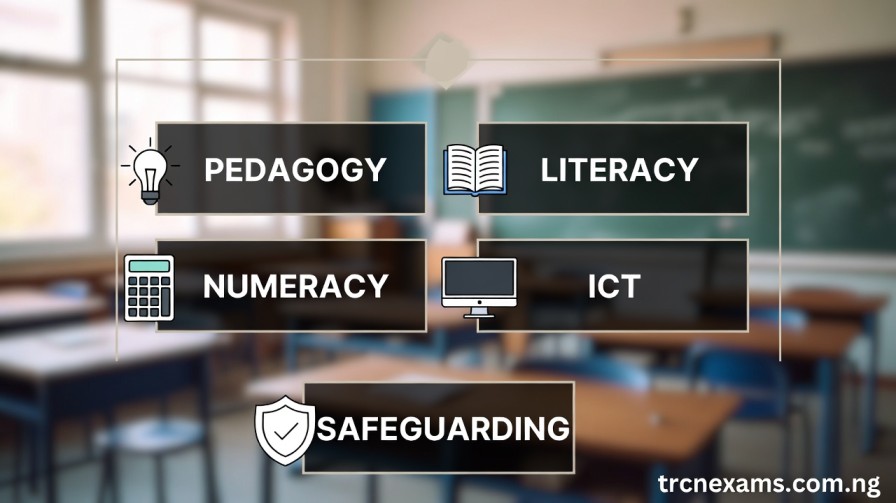
The current TRCN PQE curriculum is structured around five core areas: Pedagogy, Literacy, Numeracy, Information and Communication Technology (ICT), and Safeguarding. Each area carries an equal weighting of 20%.
This guide explains what each area involves, the important concepts candidates should revise, examples of how the knowledge applies to teaching and practical ways to prepare.
Whether you hold an NCE, bachelor’s degree, master’s degree or doctorate, understanding these five areas will help you approach your examination preparation more systematically.
1. Understanding the Current TRCN PQE Syllabus
The Professional Qualifying Examination is an assessment administered by the Teachers Registration Council of Nigeria as part of its professional teacher registration framework.
According to the Council’s published curriculum guide, the examination has the following structure:
| Examination feature | Published information |
|---|---|
| Examination | Professional Qualifying Examination (PQE) |
| Format | Computer-Based Test (CBT) |
| Number of questions | 60 |
| Duration | 60 minutes |
| Core subject areas | Five |
| Weighting per subject area | 20% |
| Published examination diets | May and November |
The five subject areas are:
- Pedagogy – 20%.
- Literacy – 20%.
- Numeracy – 20%.
- Information and Communication Technology – 20%.
- Safeguarding – 20%.
The equal weighting is an important feature of the current examination structure.
It means candidates should avoid concentrating exclusively on one area. A strong understanding of teaching methods, for example, does not remove the need to prepare for numerical reasoning, communication skills, ICT and safeguarding.
How should candidates interpret the 20% weighting?
Each subject area represents one-fifth of the overall examination weighting.
For study planning, this suggests that candidates should distribute their revision across the five areas rather than neglecting particular subjects.
If the examination follows its published weighting in a 60-question paper, each area represents an equivalent share of the overall assessment. However, candidates should not assume that every individual examination paper will necessarily contain an identical fixed number of questions from each area unless TRCN expressly confirms that arrangement.
For the official curriculum and examination information, consult the TRCN PQE Curriculum Guide.
2. Pedagogy: Understanding the Principles and Practice of Teaching
Published curriculum weighting: 20%
Pedagogy is concerned with the principles, methods and practices involved in teaching and learning.
It is one of the most important foundations of professional teaching because it addresses how teachers organise instruction, communicate knowledge, engage learners and assess educational progress.
A teacher’s responsibility is not simply to stand before a class and deliver information. Effective teaching requires planning, an understanding of learners’ needs, appropriate instructional methods and the ability to determine whether learning has taken place.
For this reason, candidates should understand both the theoretical and practical dimensions of teaching.
Important pedagogy topics to revise
The following topics provide a practical revision framework for pedagogy:
A. Teaching and learning principles
Understand the relationship between teaching and learning, the characteristics of effective instruction and the factors that influence learners’ participation and achievement.
Study:
- Meaning and nature of teaching.
- Meaning and principles of learning.
- Characteristics of effective teaching.
- Factors affecting learning.
- Teacher and learner responsibilities.
- Learner-centred and teacher-centred approaches.
B. Learning theories
Learning theories explain how individuals acquire knowledge, develop skills and modify behaviour.
Candidates should understand the major learning perspectives and their classroom applications.
Important theories include:
- Behaviourism.
- Cognitivism.
- Constructivism.
- Social learning theory.
- Humanistic approaches to learning.
For example, behaviourism emphasises observable changes in behaviour and the role of reinforcement. Constructivist approaches emphasise the active role learners play in constructing understanding through experience and interaction.
Candidates should be able to distinguish between these perspectives and understand how teachers can apply them appropriately.
C. Instructional methods and teaching strategies
Teaching methods influence how information is presented and how learners participate in classroom activities.
Revise:
- Lecture method.
- Discussion method.
- Demonstration method.
- Question-and-answer method.
- Project-based learning.
- Discovery learning.
- Problem-solving approach.
- Cooperative learning.
- Inquiry-based learning.
A good teacher selects an instructional method according to the lesson objectives, subject content, available resources and characteristics of the learners.
For example, a demonstration may be more appropriate than a lecture when teaching learners how to carry out a practical science procedure.
D. Lesson planning and instructional objectives
Lesson planning provides a structure for effective classroom instruction.
Candidates should understand:
- Meaning and importance of lesson planning.
- Learning objectives.
- Lesson introduction and development.
- Selection of teaching and learning resources.
- Lesson evaluation.
- Lesson closure.
- Alignment of objectives, activities and assessment.
A useful concept to revise is Bloom’s Taxonomy, which helps teachers classify learning objectives according to levels of thinking.
These include remembering, understanding, applying, analysing, evaluating and creating.
E. Classroom management
Classroom management involves organising the learning environment and guiding learners’ behaviour in ways that support effective instruction.
Important areas include:
- Classroom rules and routines.
- Learner motivation.
- Positive discipline.
- Managing disruptive behaviour.
- Time management.
- Classroom organisation.
- Teacher-learner relationships.
- Creating an inclusive learning environment.
For instance, a teacher dealing with repeated classroom interruptions should identify possible causes, communicate expectations clearly and apply appropriate behaviour-management strategies rather than relying entirely on punishment.
F. Assessment and evaluation
Assessment helps teachers determine whether learners have achieved intended learning outcomes.
Candidates should understand the differences between:
- Formative assessment.
- Summative assessment.
- Diagnostic assessment.
- Continuous assessment.
- Assessment for learning.
- Assessment of learning.
They should also revise feedback, test construction, marking, record keeping and the interpretation of assessment results.
Practical pedagogy example
A teacher introduces a lesson on environmental pollution.
Instead of simply dictating notes, the teacher begins by asking learners to identify sources of pollution within their community. Learners discuss their observations, examine pictures and suggest ways of reducing pollution.
The teacher then assesses their understanding through questions and a short written activity.
This example demonstrates lesson introduction, learner participation, use of instructional resources, questioning and assessment.
Candidates should practise recognising the teaching principles illustrated in situations like this.
3. Literacy: Reading, Writing and Effective Communication
Published curriculum weighting: 20%
Literacy is the ability to understand, interpret and communicate information effectively through language.
Teachers depend on literacy skills when explaining concepts, preparing lesson notes, communicating with parents, giving instructions and assessing learners’ written work.
The TRCN curriculum specifically describes literacy as an area concerned with developing strong reading, writing and communication skills.
The official curriculum page provides the following breakdown:
| Literacy component | Published weighting within Literacy |
|---|---|
| Reading comprehension | 30% |
| Grammar and structure | 25% |
| Vocabulary | 20% |
| Writing skills | 10% |
| Professional communication skills | 15% |
These percentages describe the published Literacy component, not the weighting of the entire PQE examination.
Important literacy topics to revise
A. Reading comprehension
Reading comprehension involves understanding written passages and interpreting the information they contain.
Candidates should practise:
- Identifying the main idea of a passage.
- Recognising supporting details.
- Understanding implied meanings.
- Drawing logical conclusions.
- Identifying an author’s purpose.
- Interpreting information from context.
- Distinguishing facts from opinions.
For example, a passage may describe the importance of continuous assessment in schools. A question may ask candidates to identify the central argument or determine why the author considers assessment important.
The correct response requires understanding the passage rather than relying on guesswork.
B. Grammar and sentence structure
Grammar provides the rules governing how words are organised into meaningful sentences.
Candidates should revise:
- Parts of speech.
- Subject-verb agreement.
- Tenses.
- Pronouns.
- Prepositions.
- Conjunctions.
- Articles.
- Sentence construction.
- Punctuation.
- Active and passive voice.
- Direct and indirect speech.
A common example involves subject-verb agreement.
Incorrect: The teacher explain the lesson every morning.
Correct: The teacher explains the lesson every morning.
The verb must agree with the subject.
C. Vocabulary development
Vocabulary refers to the words a person understands and uses in communication.
Candidates should practise:
- Synonyms.
- Antonyms.
- Word meanings.
- Contextual interpretation.
- Idiomatic expressions.
- Word relationships.
- Appropriate word selection.
For example, the word evaluate means to assess or judge the value, quality or effectiveness of something.
Understanding vocabulary in context is particularly important because the same word may carry different meanings in different situations.
D. Writing skills
Writing skills involve communicating information clearly and correctly in written form.
Candidates should revise:
- Sentence construction.
- Paragraph development.
- Organisation of ideas.
- Coherence and cohesion.
- Formal writing.
- Grammar and punctuation.
- Appropriate tone and expression.
A well-written paragraph should present a clear central idea and develop it through logically connected sentences.
E. Professional communication skills
Teachers communicate with different groups within the school environment.
These include learners, parents, colleagues, school administrators and other education stakeholders.
Professional communication requires:
- Clarity.
- Appropriate language.
- Respectful expression.
- Active listening.
- Accurate information sharing.
- Proper written communication.
- Professional conduct.
For example, when informing a parent about a learner’s academic difficulties, a teacher should communicate respectfully, provide relevant information and focus on constructive ways to support the learner.
Practical literacy example
Read the following statement:
“Effective teaching requires teachers to explain ideas clearly, assess learners regularly and provide feedback that helps them improve.”
A suitable central idea is that effective teaching involves clear communication, assessment and constructive feedback.
This illustrates the importance of identifying the main idea rather than concentrating on individual words alone.
4. Numeracy: Mathematical Reasoning and Practical Problem-Solving
Published curriculum weighting: 20%
Numeracy refers to the ability to understand and use mathematical information in everyday and professional situations.
Teachers use numerical reasoning when recording examination scores, calculating percentages, interpreting assessment results, organising classroom information and explaining mathematical concepts.
Numeracy should not be approached as a subject reserved exclusively for mathematics teachers. Every teacher benefits from being able to interpret numerical information accurately.
Important numeracy topics to revise
The following areas provide a useful preparation framework.
A. Basic arithmetic
Revise the four fundamental mathematical operations:
- Addition.
- Subtraction.
- Multiplication.
- Division.
Candidates should be comfortable solving problems involving whole numbers, decimals and everyday numerical situations.
Example:
A teacher has 48 exercise books and distributes them equally among 6 learners.
Each learner receives 8 exercise books.
B. Fractions and decimals
Fractions represent parts of a whole, while decimals provide another way of expressing numerical values.
Candidates should understand:
- Proper fractions.
- Improper fractions.
- Mixed numbers.
- Equivalent fractions.
- Fraction addition and subtraction.
- Decimal conversion.
- Comparison of fractions and decimals.
Example:
Understanding these relationships makes it easier to solve different types of numerical questions.
C. Percentages
Percentages express a quantity as a fraction of 100.
This is particularly useful in calculating examination results and interpreting performance data.
Example:
A learner scores 36 out of 60 in a test.
The learner’s score is 60%.
D. Ratios and proportions
Ratios compare two or more quantities.
For example, if a classroom has 20 boys and 30 girls, the ratio of boys to girls is:
[ 20:30 = 2:3 ]
Candidates should understand how to simplify ratios and solve simple proportion problems.
E. Measurement
Measurement involves determining quantities such as:
- Length.
- Mass.
- Time.
- Capacity.
- Area.
- Volume.
Candidates should understand common measurement units and basic conversions.
F. Data interpretation
Teachers frequently work with information presented in tables, charts and graphs.
Candidates should practise:
- Reading tables.
- Interpreting bar charts.
- Understanding line graphs.
- Comparing numerical values.
- Calculating averages.
- Identifying patterns in data.
For example, a teacher may compare the examination performance of learners across three terms to determine whether overall achievement is improving.
G. Mathematical reasoning
Numerical reasoning involves identifying relationships, solving problems and selecting appropriate mathematical procedures.
Candidates should practise reading word problems carefully, identifying the information provided and deciding which operation or formula is required.
Practical numeracy example
A class has 40 learners. If 30 learners pass an examination, what percentage passed?
Therefore, 75% of the learners passed.
This type of calculation is useful in educational assessment and school record interpretation.
5. Information and Communication Technology (ICT): Digital Skills for Modern Teachers
Published curriculum weighting: 20%
Information and Communication Technology refers to the digital tools and systems used to create, process, store, retrieve and communicate information.
Technology has become increasingly relevant to education. Teachers use computers, digital learning materials, online platforms and communication tools to support classroom instruction and professional activities.
However, ICT competence is not limited to knowing how to operate a computer. Teachers should also understand responsible technology use, digital safety and the educational value of different digital resources.
Important ICT topics to revise
The following areas form a practical study framework.
A. Computer fundamentals
Understand the basic components and functions of a computer.
Revise:
- Meaning of a computer.
- Input devices.
- Output devices.
- Processing devices.
- Storage devices.
- Hardware.
- Software.
- Operating systems.
- Basic computer operations.
Examples of input devices include keyboards, mice and scanners.
Examples of output devices include monitors, printers and speakers.
B. Computer hardware and software
Hardware refers to the physical components of a computer, while software consists of the programmes and instructions that enable the computer to perform tasks.
Candidates should understand the distinction and identify common examples.
For instance, a monitor is hardware, while a word-processing application is software.
C. Word processing and presentation applications
Teachers often use office applications to prepare educational materials.
Revise:
- Creating and editing documents.
- Formatting text.
- Saving and retrieving files.
- Preparing presentations.
- Using spreadsheets.
- Basic data organisation.
A teacher may use a word processor to prepare examination questions or a presentation application to explain a topic visually.
D. Internet and digital communication
The internet allows users to access and exchange information across connected computer networks.
Candidates should understand:
- Web browsers.
- Search engines.
- Email.
- Online communication.
- Educational websites.
- Downloading and uploading files.
- Responsible online behaviour.
Teachers should also understand that not every item of information found online is accurate or suitable for classroom use.
E. ICT in teaching and learning
Digital technology can support teaching through:
- Educational videos.
- Digital presentations.
- Online learning platforms.
- Electronic learning materials.
- Computer-based assessments.
- Virtual learning environments.
The effectiveness of a digital tool depends on how appropriately it is selected and used to achieve learning objectives.
F. Digital safety and cybersecurity
Responsible technology use includes protecting personal information and avoiding unsafe online activities.
Candidates should revise:
- Strong passwords.
- Phishing awareness.
- Malware.
- Safe browsing.
- Privacy protection.
- Responsible information sharing.
- Digital identity.
- Cybersecurity awareness.
Teachers should be particularly careful when handling learners’ personal information and communicating through digital platforms.
Practical ICT example
A teacher prepares a presentation containing diagrams and illustrations to explain the human digestive system.
The teacher displays the presentation using a computer and projector, explains each stage and asks learners questions.
This illustrates the use of digital resources to support instruction.
However, the teacher must ensure that the content is accurate, age-appropriate and relevant to the lesson objectives.
6. Safeguarding: Protecting Learners and Promoting Safe Schools
Published curriculum weighting: 20%
Safeguarding concerns the protection of learners from abuse, neglect, exploitation and other forms of harm.
Teachers occupy positions of trust and responsibility. They interact with children and young people regularly and may be among the first adults to notice signs that a learner is experiencing difficulties.
Safeguarding therefore involves more than maintaining classroom discipline. It includes recognising risks, understanding professional boundaries, responding appropriately to concerns and following established protection procedures.
Important safeguarding topics to revise
The following topics provide a practical framework for candidate preparation.
A. Child protection principles
Understand the importance of protecting children from harm and promoting their welfare.
Revise:
- Meaning of child protection.
- Children’s rights.
- Best interests of the child.
- Protection from abuse and neglect.
- Safe learning environments.
- Responsibilities of teachers.
B. Types of abuse and neglect
Candidates should understand common forms of abuse and neglect, including:
- Physical abuse.
- Emotional or psychological abuse.
- Sexual abuse.
- Neglect.
- Exploitation.
- Bullying and harassment.
Teachers should understand that signs of abuse may not always be obvious.
A learner’s sudden behavioural change, unexplained injuries, persistent fear or repeated absence may require appropriate attention, although no single sign should automatically be treated as proof of abuse.
C. Recognising safeguarding concerns
Teachers should be able to recognise circumstances that may indicate that a learner is at risk.
This involves observing changes in behaviour, listening carefully to concerns and following appropriate school procedures.
Teachers should avoid making assumptions or conducting independent investigations beyond their professional responsibilities.
D. Reporting and responding to concerns
When a learner discloses a safeguarding concern, the teacher should:
- Listen calmly and take the disclosure seriously.
- Avoid blaming or interrogating the learner.
- Avoid promising absolute secrecy.
- Record relevant information accurately and appropriately.
- Follow the school’s established safeguarding and reporting procedures.
- Refer the concern to the designated responsible person or appropriate authority in accordance with applicable requirements.
The safety and welfare of the learner should remain the priority.
E. Professional boundaries
Teachers must maintain appropriate professional relationships with learners.
This includes:
- Respectful communication.
- Appropriate physical boundaries.
- Responsible use of digital communication.
- Avoiding favouritism and exploitation.
- Maintaining professional conduct.
- Protecting confidential information appropriately.
F. Bullying prevention and school safety
A safe learning environment requires active efforts to prevent intimidation, discrimination, harassment and violence.
Teachers should understand the importance of reporting concerns, supporting affected learners and applying appropriate school policies.
Practical safeguarding example
A learner approaches a teacher and reports that another adult has been hurting them.
The teacher should listen calmly, take the disclosure seriously and follow the school’s safeguarding reporting procedure.
The teacher should not dismiss the learner, promise to keep the matter completely secret or attempt to investigate the allegation independently.
This type of professional judgement is important in safeguarding practice.
7. How the Five PQE Areas Work Together
Although the five areas are examined separately in the curriculum structure, they are closely connected in real teaching situations.
Consider a teacher preparing a lesson for a class.
The teacher uses pedagogy to plan the lesson and select an appropriate teaching method.
Literacy supports clear explanations, instructions and communication.
Numeracy helps the teacher interpret learners’ scores and present numerical information accurately.
ICT may be used to prepare a digital presentation or access educational resources.
Safeguarding ensures that the learning environment protects learners and respects their welfare.
This illustrates why professional teaching requires a combination of knowledge and practical skills.
Candidates should therefore avoid treating the five areas as completely unrelated subjects.
8. How to Organise Your TRCN PQE Study Timetable
A good revision timetable should give adequate attention to all five subject areas.
The following is a suggested seven-day study framework. It is an independent preparation recommendation, not an official TRCN timetable.
| Day | Study area | Recommended revision activities |
|---|---|---|
| Monday | Pedagogy | Learning theories, teaching methods and lesson planning |
| Tuesday | Literacy | Comprehension, grammar, vocabulary and communication |
| Wednesday | Numeracy | Arithmetic, fractions, percentages and data interpretation |
| Thursday | ICT | Computer fundamentals, applications and digital safety |
| Friday | Safeguarding | Child protection, professional boundaries and reporting |
| Saturday | Combined revision | Attempt questions across all five areas |
| Sunday | Performance review | Analyse mistakes and revisit difficult concepts |
Candidates who have more preparation time should repeat the cycle, explore topics in greater depth and increase the difficulty of their practice questions.
How much time should you spend on each area?
Because the five areas have equal published weightings, a balanced study plan is a sensible starting point.
However, equal examination weighting does not necessarily mean every candidate needs to spend exactly the same number of study hours on each subject.
A candidate who struggles with numeracy may need additional practice in mathematical reasoning. Another candidate may require more time to improve reading comprehension or digital literacy.
Your study time should therefore reflect both the examination structure and your individual learning needs.
9. Sample TRCN-Style Practice Questions Across the Five Areas
The following questions are original practice questions developed for revision. They are not represented as actual historical TRCN examination questions.
Question 1: Pedagogy
Which of the following approaches is most appropriate when a teacher wants learners to actively investigate a problem and develop their own understanding?
A. Dictation method
B. Inquiry-based learning
C. Punishment-based instruction
D. Continuous copying of notes
Correct answer: B. Inquiry-based learning
Explanation: Inquiry-based learning encourages learners to ask questions, investigate problems, examine evidence and develop understanding through active participation.
Question 2: Literacy
Choose the grammatically correct sentence.
A. The teachers was present at the meeting.
B. The teachers were present at the meeting.
C. The teachers is present at the meeting.
D. The teachers has present at the meeting.
Correct answer: B. The teachers were present at the meeting.
Explanation: The plural subject “teachers” requires the plural verb “were” in this sentence.
Question 3: Numeracy
A learner scores 42 marks out of a total of 60. What percentage did the learner obtain?
A. 60%
B. 65%
C. 70%
D. 75%
Correct answer: C. 70%
Explanation:
The learner obtained 70%.
Question 4: ICT
Which of the following is an example of an input device?
A. Monitor
B. Printer
C. Keyboard
D. Speaker
Correct answer: C. Keyboard
Explanation: A keyboard allows users to enter information and commands into a computer. It is therefore an input device.
Question 5: Safeguarding
A learner reports a safeguarding concern to a teacher. What should the teacher do first?
A. Ignore the disclosure until another learner confirms it.
B. Promise the learner that nobody will ever be told.
C. Listen calmly, take the concern seriously and follow the appropriate reporting procedure.
D. Discuss the allegation openly with the entire class.
Correct answer: C. Listen calmly, take the concern seriously and follow the appropriate reporting procedure.
Explanation: The teacher must respond responsibly, protect the learner’s welfare and follow established safeguarding procedures.
10. How to Use Practice Questions to Improve Your Preparation
Practice questions are useful when they are connected to the curriculum and accompanied by explanations.
However, completing hundreds of questions without understanding the answers may not produce meaningful improvement.
A more effective method is to use a three-stage revision process.
Stage 1: Attempt the question independently.
Read the question carefully, identify what it is testing and select your answer without immediately checking the solution.
Stage 2: Study the explanation.
Understand why the correct option is appropriate. If you selected an incorrect answer, identify the misconception or knowledge gap responsible.
Stage 3: Revise the underlying concept.
Return to the relevant subject area and study the concept again. Then attempt another question to determine whether your understanding has improved.
Candidates can use the following resources on TRCNExams.com.ng:
- Free TRCN CBT Practice – for practising examination-style questions.
- TRCN Past Questions and Answers PDF – for additional revision materials.
- TRCN Preparation Products – for available study resources.
- How the TRCN CBT Interface Works – for understanding computer-based examination navigation.
Always distinguish independently written practice questions from verified historical examination questions.
11. Common Mistakes Candidates Should Avoid When Studying the Syllabus
Mistake 1: Studying only pedagogy
Teaching methods and educational theories are important, but the current curriculum also includes literacy, numeracy, ICT and safeguarding.
Mistake 2: Ignoring literacy and numeracy
Some candidates assume that these subjects are too basic to require revision. This can be a costly preparation mistake, particularly when questions involve comprehension, grammar, calculations or numerical interpretation.
Mistake 3: Treating ICT as computer operation alone
ICT preparation should include digital communication, educational technology, responsible internet use and basic cybersecurity awareness.
Mistake 4: Treating safeguarding as ordinary classroom discipline
Safeguarding is concerned with protecting learners from harm. It involves professional responsibilities that go beyond maintaining order in the classroom.
Mistake 5: Depending entirely on memorised answers
A question may test the same concept using a different classroom situation or wording. Understanding the underlying principle is more useful than memorising an answer letter.
Mistake 6: Using outdated syllabus information without checking
Older educational materials may contain course structures that do not correspond to the current streamlined PQE curriculum.
Candidates should always compare their study materials with the latest official TRCN curriculum.
For additional guidance, read our article on common TRCN examination preparation mistakes and how to avoid them.
12. Frequently Asked Questions About the TRCN PQE Syllabus
How many subjects are in the current TRCN PQE syllabus?
The current published PQE curriculum contains five core areas: Pedagogy, Literacy, Numeracy, ICT and Safeguarding.
What percentage does each subject carry?
Each of the five core areas carries 20% of the overall examination weighting.
Is the TRCN PQE syllabus the same for Categories A, B, C and D?
The current published curriculum is organised around the same five core areas. Candidates should follow the examination instructions applicable to their registration category and examination diet.
How many questions are in the TRCN PQE?
The official curriculum guide publishes a structure of 60 questions.
How long is the TRCN PQE examination?
The published duration is 60 minutes.
What topics should I study under Pedagogy?
Useful revision topics include teaching and learning principles, learning theories, instructional methods, lesson planning, classroom management, learner engagement and assessment.
These topics provide a study framework; candidates should consult the official curriculum for the Council’s published requirements.
What should I study under Literacy?
The official literacy breakdown includes reading comprehension, grammar and structure, vocabulary, writing skills and professional communication skills.
What should I study under Numeracy?
Candidates should practise basic arithmetic, fractions, decimals, percentages, ratios, measurement, data interpretation and mathematical reasoning.
These are recommended preparation topics, not a claim that the Council publishes each item as a separately weighted examination subtopic.
Is ICT part of the TRCN PQE?
Yes. Information and Communication Technology is one of the five core areas and carries 20% of the published examination weighting.
What does Safeguarding mean in the TRCN examination?
Safeguarding concerns protecting learners from abuse, neglect, exploitation and other forms of harm. It includes professional responsibilities, recognising concerns and following appropriate reporting procedures.
Can I use past questions to prepare for the PQE?
Yes. Practice questions can help candidates test their understanding and identify weaknesses. They should be used alongside the official curriculum and reliable educational materials.
Where can I find the official TRCN PQE syllabus?
Candidates can consult the official curriculum at:
https://public.trcn.gov.ng/pqe-curriculum
13. Final Preparation Advice for TRCN Candidates
Understanding the TRCN PQE syllabus is one of the most important steps towards organised examination preparation.
The five core areas represent different aspects of professional competence. Pedagogy develops understanding of teaching and learning, literacy supports effective communication, numeracy strengthens mathematical reasoning, ICT builds digital competence and safeguarding reinforces the responsibility to protect learners.
Candidates should approach each area systematically rather than relying on assumptions about which subjects may be easier or more important.
Start with the official curriculum, identify your weaker areas, establish a realistic revision timetable and use practice questions to measure your progress.
Most importantly, focus on understanding the concepts and applying them to practical teaching situations.
A well-planned preparation process can help you approach the Professional Qualifying Examination with greater confidence and a clearer understanding of the knowledge expected of a professional teacher.
Suggested Articles:
1 thought on “TRCN Exam Syllabus 2027 – Full Guide”
Comments are closed.