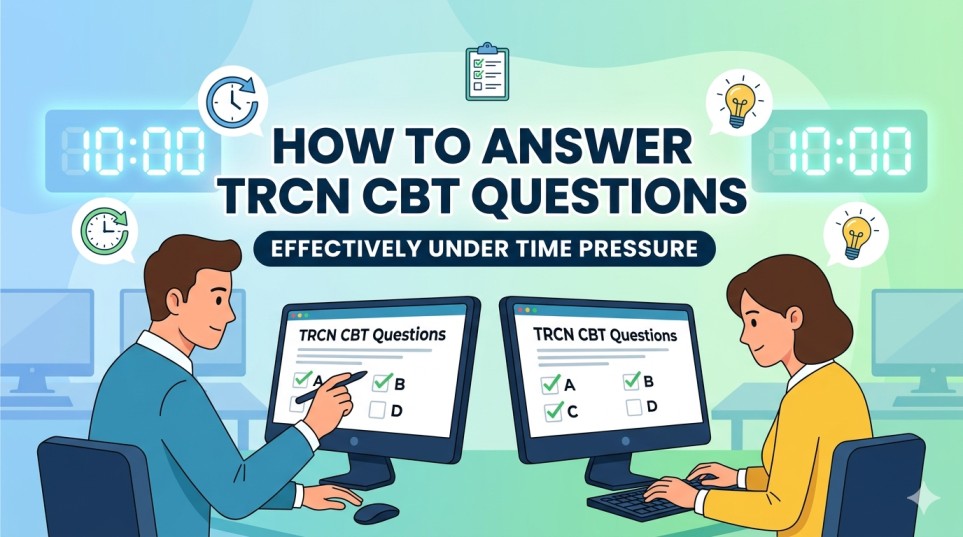
The TRCN Professional Qualifying Examination (PQE) is a Computer-Based Test (CBT) consisting of 60 multiple-choice questions to be answered in 60 minutes. This gives you roughly one minute per question on average. Many candidates know the material but still struggle due to poor time management, anxiety, or ineffective answering strategies.
Mastering these techniques can significantly boost your score and help you pass on your first attempt.
1. Understand the Exam Format Thoroughly
- 60 Objective Questions in 60 minutes.
- Questions cover key areas: Philosophy of Education, Educational Psychology, Sociology of Education, Curriculum Studies, Measurement & Evaluation, Teaching Methods, etc.
- All questions are multiple-choice (usually 4 options: A–D).
- You can review and change answers before final submission.
- A basic on-screen calculator may be available for numeracy questions.
Knowing this helps you approach the exam with confidence and a clear plan.
2. Pre-Exam Preparation Strategies (Build Speed Before the D-Day)
- Practice Full Timed Mock Exams — Simulate the exact conditions: 60 questions in 60 minutes. Use past questions and online CBT platforms. Aim to complete at least 10 full mocks before the exam.
- Master the Syllabus — Focus more on high-yield topics (Educational Psychology, Teaching Methods, Measurement & Evaluation often carry more weight).
- Improve Reading Speed — Train yourself to read questions quickly while understanding the key requirement (what exactly is being asked?).
- Learn Common Traps — TRCN questions often include distractors that sound correct but are not the best answer. Always look for keywords like “most appropriate,” “primary,” or “best.”
3. Time Management Techniques During the Exam
| Phase | Time Allocation | Action |
|---|---|---|
| Initial Scan | First 2–3 minutes | Quickly go through all questions and flag difficult ones |
| First Pass (Easy) | 30–35 minutes | Answer all questions you are sure of |
| Second Pass (Medium/Hard) | Remaining time | Tackle flagged questions |
| Final Review | Last 5 minutes | Check for errors and unanswered questions |
Golden Rule: Never spend more than 1.5 minutes on a single question during the first pass. If unsure, flag and move on.
4. Smart Answering Strategies Under Pressure
- Read the Question Carefully — But don’t over-read. Focus on the stem and eliminate obviously wrong options first (process of elimination). This can increase your chances from 25% to 50%+ even when guessing.
- Use the Flag Feature — Mark uncertain questions and return later. This prevents you from getting stuck.
- Keyword Strategy — Look for absolute words (always, never, all, none) — these are often wrong. Prefer qualified answers (usually, often, best, most).
- Educated Guessing — If you must guess, eliminate two options first. Never leave any question blank — there is no negative marking.
- Scenario-Based Questions — These are common in Psychology and Methods. Always think: “What is the best practice in a real Nigerian classroom?”
5. Psychological and Physical Tips to Stay Calm
- Control Anxiety — Take 2–3 deep breaths before starting and whenever you feel overwhelmed. Positive self-talk: “I am well-prepared. One question at a time.”
- Posture and Focus — Sit upright, keep eyes on the screen, and avoid looking at other candidates.
- Pace Yourself — If you finish early, use the remaining time to review flagged questions. Do not submit too early.
- On Exam Day — Arrive early, eat light, and avoid last-minute cramming.
6. Bonus Pro Tips from Successful Candidates
- Practice with a mouse and keyboard beforehand if you’re not very computer literate.
- For subjects like Numeracy or ICT, quickly attempt them when fresh.
- Group similar topics during study (e.g., all Psychology theories together) to build connections.
- After each mock test, review wrong answers and understand why the correct option is right.
Final Checklist Before Submission
- All questions answered (no blanks)
- Flagged questions reviewed
- No silly mistakes on easy questions
- Confidence level: Submit and leave the rest to God
Mastering time management in the TRCN CBT is a skill you can develop through consistent practice. Candidates who treat the exam like a real timed simulation almost always perform better.