Securing a teaching or support role with the Enugu State Universal Basic Education Board (ENSUBEB) in 2026 is highly competitive. Governor Peter Mbah has approved the recruitment of 6,580 staff — including 4,698 core subject teachers — with a strong focus on the state’s 267 Smart Green Schools. Applications close on Friday, 14 August 2026.
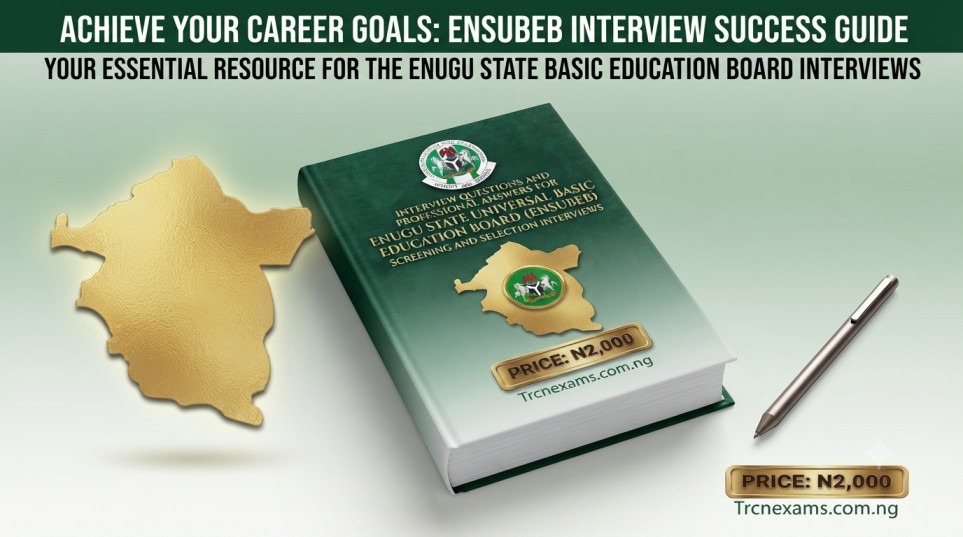
DOWNLOAD ENUGU SUBEB TEACHER’S RECRUITMENT INTERVIEW QUESTIONS AND ANSWERS FOR ALL STAFF CATEGORIES

After document verification, shortlisted candidates face an oral interview / panel screening. This stage assesses your teaching philosophy, classroom management skills, knowledge of the Universal Basic Education (UBE) framework, current education policies, and how well you can handle real classroom situations.
This guide gives you a clear understanding of the interview format, the most frequently asked questions, and professional model answers that demonstrate competence and readiness. Use it to prepare thoroughly and walk into the panel with confidence.
Understanding the 2026 ENSUBEB Recruitment & Interview Stage
ENSUBEB manages public primary and junior secondary education across Enugu State’s 17 Local Government Areas. The 2026 exercise prioritises quality teachers for core subjects (Mathematics, English Language, Basic Science, Basic Technology, ICT, French, Igbo Language, and History) plus specialised roles such as digital librarians, guidance counsellors, and ICT staff.
Key requirements for teaching positions
- B.Ed, B.Sc.Ed, or relevant degree/HND + PGDE, or NCE in the subject area
- Teachers Registration Council of Nigeria (TRCN) registration or proof of ongoing registration
- Practical ICT proficiency
- NYSC discharge or exemption certificate (for degree/HND holders)
Application is completely free. Submit a formal application letter, CV, credentials, birth certificate/affidavit, and contact details either in hard copy to the Office of the Executive Chairman, ENSUBEB, or as a single PDF to the official email.
The oral interview typically evaluates:
- Pedagogical knowledge and lesson delivery
- Classroom management and inclusive education
- Understanding of UBE policy and ENSUBEB’s role
- Communication skills, professionalism, and problem-solving
- Awareness of current education issues and Enugu State priorities (especially Smart Green Schools)
Why You Need the Complete Enugu SUBEB Interview Questions and Answers PDF
Relying solely on free snippets or guessing Interview patterns leaves your career to chance. The official study material compiled by experts provides a massive strategic advantage:
- Extensive Question Bank: Access hundreds of authentic past and predicted questions covering all screening domains.
- Detailed Explanations: Every answer comes with clear, step-by-step breakdowns so you understand why an option is correct.
- Time Management Practice: Familiarizing yourself with the format boosts your speed and reduces anxiety on exam day.
- Interview Confidence: Master the exact words, behavioral frameworks, and professional decorum expected by the ENSUBEB interview panel.
Core Areas Tested in the Oral Interview
Prepare answers that show practical experience, child-centred approaches, and alignment with national and state education goals. Panels value clear, structured responses that demonstrate empathy, professionalism, and results.
Sample Enugu SUBEB Interview Questions and Professional Answers
1. Tell us about yourself and why you want to work with ENSUBEB. Model Answer: “I am a qualified teacher with [NCE/B.Ed] in [subject] and current TRCN registration. I have [X] years of classroom experience where I focused on student-centred learning and improved learning outcomes. I am particularly motivated by Enugu State’s Smart Green Schools initiative because it combines quality basic education with modern technology and sustainability. I want to contribute to ENSUBEB’s mandate of delivering free, compulsory, and quality basic education across the state.”
2. What do you understand by the Universal Basic Education (UBE) programme? Model Answer: “The UBE programme, established under the UBE Act 2004, provides nine years of uninterrupted formal education — six years of primary and three years of junior secondary — that is free and compulsory. It aims to improve access, equity, and quality. ENSUBEB implements this policy at the state level by recruiting teachers, managing infrastructure, and ensuring effective teaching and learning.”
3. How would you handle a disruptive student who consistently interrupts your lesson? Model Answer: “I would first use non-verbal cues such as proximity or a brief pause to redirect the student without disrupting the class. If the behaviour continues, I would speak privately with the student after the lesson to understand the root cause — whether academic difficulty, home issues, or attention-seeking. I would set clear expectations, offer support, and involve the guidance counsellor or parents if needed. My goal is always to maintain a positive learning environment while helping the child succeed.”
4. Describe the correct sequence of a standard lesson plan and explain why it matters. Model Answer: “A standard lesson follows Introduction (set induction to capture attention and link to prior knowledge), Presentation (delivery of new content with activities), and Evaluation (assessment of learning). This sequence ensures students are engaged from the start, receive clear instruction, and that the teacher can measure whether objectives have been achieved. It also allows for differentiation and timely feedback.”
DOWNLOAD ENUGU SUBEB TEACHER’S RECRUITMENT INTERVIEW QUESTIONS AND ANSWERS FOR ALL STAFF CATEGORIES
5. How do you incorporate ICT into your teaching, especially in a Smart Green School setting? Model Answer: “I use ICT to make lessons interactive and relevant. Examples include digital presentations, educational videos, online quizzes, and collaborative tools. In a Smart Green School, I would leverage available technology to support differentiated instruction, track student progress, and promote digital literacy while ensuring that technology enhances rather than replaces effective teaching.”
6. What strategies would you use to support learners with special needs or mixed abilities in one classroom? Model Answer: “I practise inclusive education by differentiating content, process, and product. This includes varied activities, peer support, visual aids, simplified language when needed, and individual learning plans. I also collaborate with the school counsellor and parents to ensure every child participates meaningfully and makes progress.”
7. How do you motivate students who appear uninterested or are performing poorly? Model Answer: “I identify the underlying reasons through observation and conversation. Then I set achievable short-term goals, celebrate small successes, relate lessons to real-life experiences, and use varied teaching methods. Building a positive teacher-student relationship and showing genuine belief in the student’s ability often unlocks motivation.”
8. What is the role of the School-Based Management Committee (SBMC) and how would you work with it? Model Answer: “The SBMC brings together the school, parents, and community to support school improvement, resource mobilisation, and accountability. As a teacher I would collaborate with the SBMC by sharing student progress, participating in community engagement activities, and supporting initiatives that improve the learning environment.”
9. How would you ensure continuous professional development as a teacher under ENSUBEB? Model Answer: “I would actively participate in workshops, TRCN-mandated trainings, peer learning, and online courses. I would also reflect on my practice through lesson evaluation and seek feedback from colleagues and mentors. Continuous learning keeps my methods current and benefits my students.”
10. A parent confronts you angrily about their child’s performance. How do you respond? Model Answer: “I would remain calm and professional, listen actively without interrupting, acknowledge the parent’s concern, and present factual information about the child’s progress and the support already provided. I would then propose a collaborative plan involving the parent, the student, and myself, and schedule a follow-up. The focus stays on the child’s improvement rather than blame.”
11. Why is classroom management important, and what techniques do you use? Model Answer: “Effective classroom management creates a safe, orderly environment that maximises learning time. I establish clear rules and routines from the first day, use positive reinforcement, arrange seating purposefully, and maintain consistent, fair consequences. Prevention through engaging lessons is always my first strategy.”
12. How do you assess students beyond traditional tests? Model Answer: “I use a mix of formative and summative methods: oral questions, observations, projects, portfolios, peer assessment, and self-assessment. This gives a fuller picture of each learner’s strengths and areas for growth and allows me to adjust instruction in real time.”
13. What challenges do you foresee in teaching in a public primary or junior secondary school in Enugu, and how would you address them? Model Answer: “Possible challenges include large class sizes, varying student backgrounds, and resource constraints. I would prioritise lesson planning that maximises limited resources, use group work and peer tutoring, integrate low-cost or no-cost teaching aids, and collaborate with colleagues and the community for support.”
14. How does the Smart Green Schools initiative align with quality basic education? Model Answer: “Smart Green Schools integrate technology, modern pedagogy, and sustainable practices to improve learning outcomes and prepare students for the future. As a teacher I would use the available tools to deliver engaging, interactive lessons while modelling environmental responsibility.”
15. Do you have any questions for the panel? Good closing questions: “What professional development opportunities does ENSUBEB currently offer new teachers?” “How does the Board support teachers in implementing the Smart Green Schools curriculum?”
Practical Preparation Tips for the Oral Interview
- Research ENSUBEB’s mandate, the UBE Act 2004, and Enugu State’s current education priorities.
- Practise answers out loud so they sound natural, not memorised.
- Dress professionally and arrive early.
- Use the STAR approach (Situation, Task, Action, Result) for experience-based questions.
- Stay calm, maintain eye contact, and speak clearly.
- Show genuine passion for teaching and for Enugu children’s success.
Frequently Asked Questions
Is the interview the final stage? Yes. After document verification and any written screening, the oral interview is usually the decisive stage for final selection.
Are questions the same for teaching and non-teaching roles? Core education and policy questions appear for most candidates, but teaching applicants face more pedagogy and classroom-management questions.
How long does the interview last? Typically 10–20 minutes per candidate, depending on the panel.
Should I take documents to the interview? Yes. Carry originals and photocopies of your credentials, TRCN evidence, and application documents.
Is there a dress code? Professional formal or smart business attire is expected.
Final Advice
The candidates who succeed are those who combine solid subject knowledge with clear communication, practical classroom strategies, and genuine commitment to basic education in Enugu State. Prepare thoroughly, practise your responses, and focus on how you will add value to ENSUBEB and the Smart Green Schools.
For a complete, updated collection of additional interview questions, model answers, behavioural frameworks, and panel-specific tips compiled for the 2026 ENSUBEB screening, you can access the full professional preparation guide here: Trcnxexams.com.ng
DOWNLOAD ENUGU SUBEB TEACHER’S RECRUITMENT INTERVIEW QUESTIONS AND ANSWERS FOR ALL STAFF CATEGORIES
Start preparing today. The opportunity to shape the next generation of learners in Enugu State is worth the effort. Good luck.