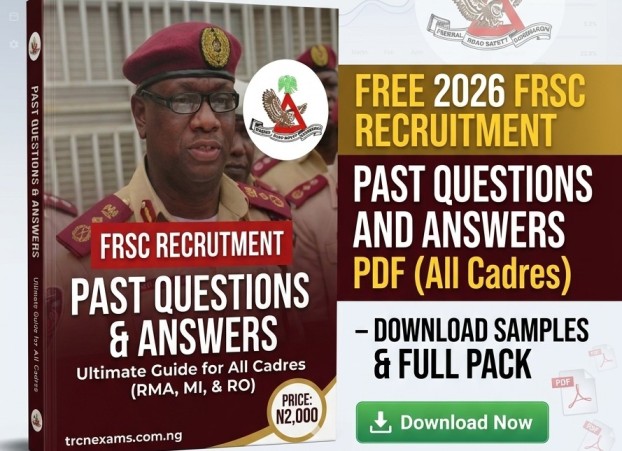
Download FREE FRSC Recruitment Past Questions and Answers PDF 2026 – All Cadres
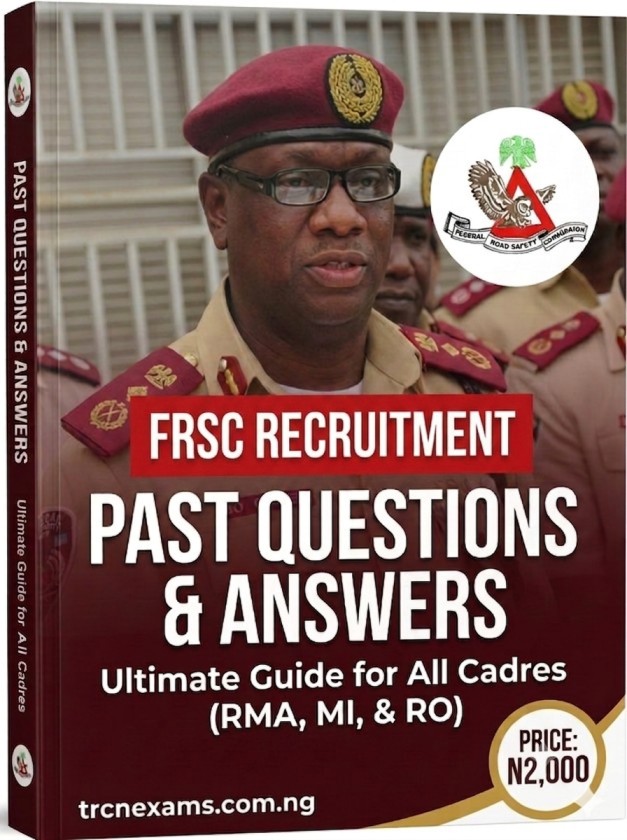
The Federal Road Safety Corps (FRSC) recruitment exercise represents one of the most highly competitive paramilitary job opportunities in Nigeria. With the application portal accepting submissions across the three primary recruitment cadres, tens of thousands of qualified Nigerians are actively applying.
Because the FRSC screening process is highly competitive, passing the Computer-Based Test (CBT) is the most critical hurdle to securing your place in the corps. To help you prepare effectively, we have compiled the ultimate preparatory resource: the Free 2026 FRSC Recruitment Past Questions and Answers PDF.
This guide features free sample questions, structured syllabus overviews, past paper structures, and an option to download the full, updated FRSC question study pack tailored to your specific cadre.
1. Overview of the 2026 FRSC Recruitment Cadres & Exam Patterns
The FRSC recruits across three main cadres, each requiring different levels of educational qualification. The CBT exam is tailored to reflect these levels, testing both general intelligence and professional knowledge.
Cadre | Typical Roles | Target Qualifications | Key CBT Subjects |
|---|---|---|---|
Officer Cadre | Assistant Route Commander (ARC), Route Commander, Medical/Specialist Officers | B.Sc, BA, HND, MBBS, LLB, B.Eng | English, Mathematics, Current Affairs, FRSC Act/General Knowledge, Logical Reasoning |
Marshal Inspectorate (MI) Cadre | Marshal Inspector I, II, III | NCE, ND/OND, RN/RM, CHEW | English, Mathematics, General Paper, Basic Science, Public Safety |
Road Marshal Assistant (RMA) Cadre | RMA II, RMA III, Drivers, Riders, Artisans | SSCE (WAEC/NECO/NABTEB), Trade Test Certs | Basic English, Basic Mathematics, Civics, Road Signs & Driving Rules |
2. Official 2026 FRSC CBT Exam Syllabus & Format
If you want to ace the FRSC CBT exam, you must align your study routine with the actual exam structure. Historically, the examination comprises 100 Multiple-Choice Questions (MCQs) to be completed in 60 minutes (1 hour).
The exam is divided into four critical areas:
Section A: English Language & Verbal Aptitude (25% to 30%)
- Focus Areas: Synonyms and Antonyms, Concord (Subject-Verb Agreement), Sentence Completion, Lexis and Structure, Idioms, and Comprehension.
- Objective: To test your written communication and instructions comprehension skills.
Section B: Mathematics & Quantitative Reasoning (25% to 30%)
- Focus Areas: Simple Interest, Percentages, Ratios and Proportions, Basic Algebra, Fractions, Decimals, and Data Interpretation.
- Objective: To evaluate your mental arithmetic, analytical problem-solving, and logical calculations under time pressure.
Section C: FRSC Act, National Road Safety Strategy & Road Signs (20% to 25%)
- Focus Areas: Meaning of common traffic signs, highway codes, historical facts about the FRSC, safety guidelines, and the establishment act of the Commission (1988 Decree/FRSC Act).
- Objective: To assess your fundamental knowledge of traffic safety operations.
Section D: Current Affairs & General Knowledge (15% to 20%)
- Focus Areas: Structure of Nigerian Government, Nigerian Constitution, Current Ministers/Heads of Paramilitary Agencies, World Geography, and Economic bodies (ECOWAS, AU, UN).
- Objective: To measure your overall awareness of national and international environments.
3. Ultimate 50-Question FRSC Practice Test (With Explanations)
To provide the highest level of study assistance, we have compiled 50 highly repeated past questions across all test categories. Study these thoroughly to understand the logical flow of the actual exam.
Category A: Road Safety, Highway Code & FRSC Establishment Act
Q1. In what year was the Federal Road Safety Commission (FRSC) established?
- A) 1985
- B) 1988
- C) 1990
- D) 1999
- Answer: B) 1988
- Explanation: The FRSC was established by the Federal Government through Decree No. 45 of 1988. This was later amended by Decree 35 of 1992 and codified into law as the FRSC (Establishment) Act 2007.
Q2. What is the standard shape of a “Stop” sign on public roads?
- A) Triangle
- B) Circle
- C) Octagon
- D) Rectangle
- Answer: C) Octagon
- Explanation: Globally, stop signs are designed as eight-sided polygons (octagons) so they are easily recognizable even from the back or when covered in dirt/snow.
Q3. What does a flashing yellow traffic light signify to a driver?
- A) Stop immediately
- B) Proceed with caution
- C) Prepare to speed up
- D) The traffic light is faulty
- Answer: B) Proceed with caution
- Explanation: A flashing yellow light acts as a warning to slow down, look both ways, yield to pedestrians, and proceed through the intersection safely.
Q4. Which of these is NOT a primary mandate of the FRSC?
- A) Making the highways safe for motorists
- B) Preventing and minimizing road traffic accidents
- C) Arresting political tax offenders on interstate highways
- D) Designing and producing driver’s licenses
- Answer: C) Arresting political tax offenders on interstate highways
- Explanation: The core mandate of the FRSC focuses strictly on road safety management, traffic regulation, and public education. Tax evasion enforcement falls under tax authorities.
Q5. What do double solid yellow lines down the center of a road indicate?
- A) Overtaking is permitted anytime
- B) Passing/Overtaking is strictly prohibited from both directions
- C) One-way traffic ahead
- D) Parking area ahead
- Answer: B) Passing/Overtaking is strictly prohibited from both directions
- Explanation: Solid center lines represent a barrier. If the line is double and solid on both sides, vehicles on either side of the road are prohibited from crossing it to pass other vehicles.
Q6. What is the maximum speed limit for private cars on expressways in Nigeria?
- A) 80 km/h
- B) 100 km/h
- C) 120 km/h
- D) 140 km/h
- Answer: B) 100 km/h
- Explanation: According to the Nigerian Highway Code, the official maximum speed limit for private cars on an expressway is 100\text{ km/h}, unless otherwise stated by speed limit signs in specific zones.
Q7. Who is recognized as the founding Chairman of the FRSC?
- A) Prof. Wole Soyinka
- B) Dr. Olu Agunloye
- C) Major General Halidu Hannaniya
- D) Boboye Oyeyemi
- Answer: A) Prof. Wole Soyinka
- Explanation: Nobel Laureate Prof. Wole Soyinka was appointed as the pioneer Chairman of the Governing Board of the FRSC in 1988, helping build its early structural framework.
Q8. What does the acronym “NVIS” stand for in FRSC operations?
- A) National Vehicle Inspection Scheme
- B) National Vehicle Identification System
- C) Network Vehicle Information Security
- D) National Valued Identification System
- Answer: B) National Vehicle Identification System
- Explanation: NVIS is the database program run by the FRSC to keep comprehensive national records of vehicle registration, licensing, and plate numbers.
Q9. When approaching a roundabout, which vehicle has the ultimate right of way?
- A) Vehicles attempting to enter the roundabout
- B) Vehicles already inside the roundabout
- C) Heavy-duty trucks only
- D) Vehicles signaling a left turn
- Answer: B) Vehicles already inside the roundabout
- Explanation: The universal rule of the road states that drivers must yield to vehicles already circulating inside a roundabout.
Q10. What does an inverted (upside down) triangular road sign mean?
- A) Yield / Give Way
- B) Pedestrian crossing
- C) Hospital zone
- D) Speed limit zone
- Answer: A) Yield / Give Way
- Explanation: An inverted triangle with a red border is the international regulatory symbol for “Yield” or “Give Way,” prompting drivers to give precedence to other traffic.
Q11. Which tier of the FRSC contains the ranks of Deputy Corps Marshal and Assistant Corps Marshal?
- A) Marshal Inspectorate Cadre
- B) Road Marshal Assistant Cadre
- C) Officer Cadre
- D) Technical Cadre
- Answer: C) Officer Cadre
- Explanation: The Officer Cadre is the executive command structure of the FRSC, ranging from Assistant Route Commander (ARC) up to the ultimate rank of Corps Marshal.
Q12. Under the FRSC Act, driving a vehicle with worn-out or expired tires is an offense classified under:
- A) Speed Limit Violation
- B) Use of Phone while Driving
- C) Road Unworthiness / Tire Violation
- D) Dangerous Driving
- Answer: C) Road Unworthiness / Tire Violation
- Explanation: Driving with bald, expired, or substandard tires compromises vehicle traction and braking distance, which is penalized as a vehicle maintenance safety offense.
Q13. How many years is the maximum validity period for a standard Nigerian Driver’s License?
- A) 2 years
- B) 3 or 5 years
- C) 10 years
- D) Lifetime validity
- Answer: B) 3 or 5 years
- Explanation: Motorists in Nigeria have the legal option to pay for and renew their driver’s licenses for either a 3-year period or a 5-year period.
Category B: English Language & Verbal Aptitude
Q14. Choose the option that best completes the sentence: “The management board will celebrate _______ 38th anniversary next week.”
- A) their
- B) her
- C) its
- D) it’s
- Answer: C) its
- Explanation: “Management board” is a singular collective noun. It requires the singular possessive pronoun “its” (without an apostrophe). “It’s” is a contraction of “it is.”
Q15. Identify the word closest in meaning (synonym) to the underlined word: “The candidate was disqualified for presenting forged documents.”
- A) Promoted
- B) Barred
- C) Forgiven
- D) Nominated
- Answer: B) Barred
- Explanation: To disqualify means to render someone ineligible or officially bar them from participating in an activity or office.
Q16. Choose the correct spelling from the options below:
- A) Commisioner
- B) Commissioner
- C) Commisionar
- D) Comissioner
- Answer: B) Commissioner
- Explanation: The correct spelling contains a double ‘m’, double ‘s’, and ends with ‘er’.
Q17. Fill in the blank with the most appropriate preposition: “The driver was charged _______ reckless driving.”
- A) of
- B) with
- C) for
- D) about
- Answer: B) with
- Explanation: Idiomatically, one is “charged with” a crime or misdemeanor.
Q18. Choose the option that is opposite in meaning (antonym) to: HASTY
- A) Rapid
- B) Deliberate
- C) Sudden
- D) Careless
- Answer: B) Deliberate
- Explanation: “Hasty” means done with excessive, unguided speed. Its direct opposite is “deliberate,” which implies taking time to plan and act thoughtfully.
Q19. Complete the sentence: “Neither the driver nor the passengers _______ injured in the crash.”
- A) was
- B) were
- C) is
- D) has been
- Answer: B) were
- Explanation: According to the rule of proximity (Concord), when “neither/nor” joins two subjects, the verb agrees with the subject closer to it. “Passengers” is plural, so it requires the plural verb “were.”
Q20. Find the odd one out among the following words:
- A) Ambulance
- B) Patrol Vehicle
- C) Tow Truck
- D) Submarine
- Answer: D) Submarine
- Explanation: Ambulance, patrol vehicle, and tow truck are all land-based emergency/operational vehicles used in highway management. A submarine is a marine vessel.
Q21. Choose the correct option to fill the gap: “I look forward to _______ the new Corps Marshal at the parade.”
- A) meet
- B) meeting
- C) met
- D) have met
- Answer: B) meeting
- Explanation: The phrase “look forward to” is a phrasal verb that must be followed by a gerund (noun ending in -ing). Thus, “meeting” is correct.
Q22. What is the meaning of the idiom: “To hit the road”?
- A) To damage a highway
- B) To begin a journey
- C) To have a car accident
- D) To sleep on the street
- Answer: B) To begin a journey
- Explanation: “To hit the road” is a common idiomatic expression that means to depart or set out on a trip.
Q23. Identify the passive voice of: “The officer arrested the speed offender.”
- A) The speed offender was arrested by the officer.
- B) The speed offender is arrested by the officer.
- C) The officer was arresting the speed offender.
- D) The speed offender has been arrested by the officer.
- Answer: A) The speed offender was arrested by the officer.
- Explanation: In passive voice, the object (the speed offender) becomes the subject, followed by the past tense of ‘to be’ (was) and the past participle (arrested).
Q24. Choose the synonym for IMPECCABLE:
- A) Dirty
- B) Flawless
- C) Slow
- D) Faulty
- Answer: B) Flawless
- Explanation: Impeccable means of the highest standard; faultless or flawless.
Q25. Complete the statement: “She had barely stepped out of the vehicle _______ the tire blew out.”
- A) than
- B) when
- C) then
- D) while
- Answer: B) when
- Explanation: The adverbial coordinator “scarcely… when” or “barely… when” is the standard grammatical construction. Do not pair “barely” with “than.”
Category D: Current Affairs & General Knowledge
Q37. How many Senators represent the Federal Capital Territory (FCT) in the Nigerian Senate?
- A) 1
- B) 2
- C) 3
- D) 4
- Answer: A) 1
- Explanation: While each of the 36 states has 3 senatorial districts (totaling 108 senators), the Federal Capital Territory (Abuja) is constitutionally allocated exactly 1 senatorial seat.
Q38. In which country is the International Court of Justice (ICJ) situated?
- A) United States
- B) Netherlands
- C) Switzerland
- D) United Kingdom
- Answer: B) Netherlands
- Explanation: The International Court of Justice (ICJ) is the principal judicial organ of the UN and is situated in The Hague, Netherlands.
Q39. Who is the current Minister of Interior in Nigeria?
- A) Rauf Aregbesola
- B) Olubunmi Tunji-Ojo
- C) Abba Moro
- D) Nyesom Wike
- Answer: B) Olubunmi Tunji-Ojo
- Explanation: Dr. Olubunmi Tunji-Ojo serves as the Minister of Interior, overseeing key internal security and paramilitary structures.
Q40. Which of the following is the highest national honor award in Nigeria?
- A) GCFR (Grand Commander of the Order of the Federal Republic)
- B) GCON (Grand Commander of the Order of the Niger)
- C) CFR (Commander of the Order of the Federal Republic)
- D) OFR (Officer of the Order of the Federal Republic)
- Answer: A) GCFR
- Explanation: GCFR is Nigeria’s highest national honor, typically reserved for Presidents and Heads of State.
Q41. What is the primary focus of the United Nations Sustainable Development Goal 3 (SDG 3)?
- A) No Poverty
- B) Good Health and Well-being
- C) Quality Education
- D) Climate Action
- Answer: B) Good Health and Well-being
- Explanation: SDG 3 aims to ensure healthy lives and promote well-being for all ages. Notably, target 3.6 specifically focuses on halving global deaths and injuries from road traffic accidents.
Q42. Which Nigerian river is the longest?
- A) River Benue
- B) River Niger
- C) River Kaduna
- D) River Cross
- Answer: B) River Niger
- Explanation: River Niger is the principal river of West Africa, spanning over 4,180 km. It is the longest river in Nigeria.
Q43. What is the capital of Nigeria’s newest neighboring country to the far West?
- A) Accra (Ghana)
- B) Porto-Novo (Benin Republic)
- C) Niamey (Niger)
- D) Yaoundé (Cameroon)
- Answer: B) Porto-Novo
- Explanation: The Republic of Benin borders Nigeria to the west, and its official capital city is Porto-Novo.
Q44. The administrative headquarters of the ECOWAS Commission is located in:
- A) Accra, Ghana
- B) Abuja, Nigeria
- C) Abidjan, Côte d’Ivoire
- D) Dakar, Senegal
- Answer: B) Abuja, Nigeria
- Explanation: The Economic Community of West African States (ECOWAS) has its official administrative secretariat situated in Abuja, Nigeria.
Q45. How many local government areas (LGAs) exist in Nigeria?
- A) 360
- B) 500
- C) 774
- D) 1000
- Answer: C) 774
- Explanation: The administrative structure of Nigeria is constitutionally subdivided into exactly 774 Local Government Areas.
Q46. Who was the first military Head of State of Nigeria?
- A) General Yakubu Gowon
- B) Major General J.T.U. Aguiyi-Ironsi
- C) General Olusegun Obasanjo
- D) General Murtala Muhammed
- Answer: B) Major General J.T.U. Aguiyi-Ironsi
- Explanation: Following the January 1966 coup d’état, Major General Johnson Aguiyi-Ironsi became the first military Head of State of Nigeria.
Q47. What does the “White” color on the Nigerian flag represent?
- A) Agriculture
- B) Peace and Unity
- C) Wealth
- D) Military strength
- Answer: B) Peace and Unity
- Explanation: Designed by Michael Taiwo Akinkunmi in 1959, the green stripes on the flag represent agriculture and natural wealth, while the central white stripe represents peace and unity.
Q48. Which organ of the United Nations is responsible for maintaining international peace and security?
- A) General Assembly
- B) International Court of Justice
- C) Security Council
- D) Economic and Social Council
- Answer: C) Security Council
- Explanation: The UN Security Council is tasked with maintaining global peace and security. It consists of 15 members, including 5 permanent members with veto power.
Q49. What is the maximum number of years a person can serve as President of Nigeria under the 1999 Constitution?
- A) 4 years
- B) 6 years
- C) 8 years
- D) No limit
- Answer: C) 8 years
- Explanation: The constitution limits a president to a maximum of two terms of 4 years each, totaling 8 years.
Q50. When is Nigeria’s National Democracy Day celebrated?
- A) May 29
- B) June 12
- C) October 1
- D) January 15
- Answer: B) June 12
- Explanation: In 2018, the Federal Government officially declared June 12 as Democracy Day to honor the memory of the June 12, 1993 presidential election.
4. 4-Week Strategic Study Plan to Ace the FRSC CBT
Succeeding in the FRSC exam requires organized preparation. Follow this structured 4-week plan to maximize your retention:
- Week 1: Foundations of Road Safety & Traffic Regulations
- Study the complete structure of the FRSC and the Highway Code.
- Familiarize yourself with warning, regulatory, and informative road signs.
- Study goal: Complete Module 1 past questions.
- Week 2: Advanced Verbal Reasoning & Basic Calculations
- Practice subject-verb agreement, common spelling rules, and prepositions.
- Review core mathematical concepts: simple interest, fractions, and algebra.
- Study goal: Spend 1.5 hours daily solving logic and math problems.
- Week 3: Current Affairs & Civic Responsibility
- Read up on the leadership of paramilitary forces in Nigeria.
- Review key events from the past year.
- Study goal: Memorize key political figures and international affiliations (ECOWAS, AU).
- Week 4: Simulated Mock Exams
- Set a timer for 60 minutes and complete a 100-question practice test.
- Practice managing your time efficiently (aim for 30–35 seconds per question).
- Review your mistakes and read the explanations for any incorrect answers.
5. Download the Complete 2026 FRSC Past Questions and Answers PDF
Using past exam questions is one of the most effective ways to prepare. Over 70% of questions on Nigerian paramilitary recruitment exams feature recurring concepts or direct duplicates from prior years.
Our fully updated 2026 FRSC PDF Study Pack contains actual past questions from 2012 to 2025, complete with clear, step-by-step explanations.
What is included in the Full PDF Pack?
- Cadre-Specific Standard Exams: Tailored folders for Officers, Marshal Inspectors, and Road Marshal Assistants.
- Step-by-Step Answer Explanations: Understand the underlying reasoning behind every math and grammar answer.
- Bonus Study Materials: High-resolution traffic sign charts and a current affairs guide.
- Mobile-Friendly Layout: Study on your phone, tablet, or computer anywhere, anytime.
📥 Click Here to Download the Full FRSC Past Questions & Answers Pack
Get instant access to the complete downloadable PDF study files to begin your preparation.
Disclaimer: This study pack is an independent educational resource designed to help candidates prepare for the exams. The official FRSC recruitment application process is entirely free on the official portal. Do not pay anyone for application forms or job placement.